FounderOS

Your AI forgets everything.
Your work shouldn't.

A personal AI operating system, built around how you actually work. Your knowledge lives in a base you own. An AI runs it: it briefs you every morning, preps your meetings, and answers from everything you already know and decided. The name says founders. The fit is wider.

See if it fits your work → How it works
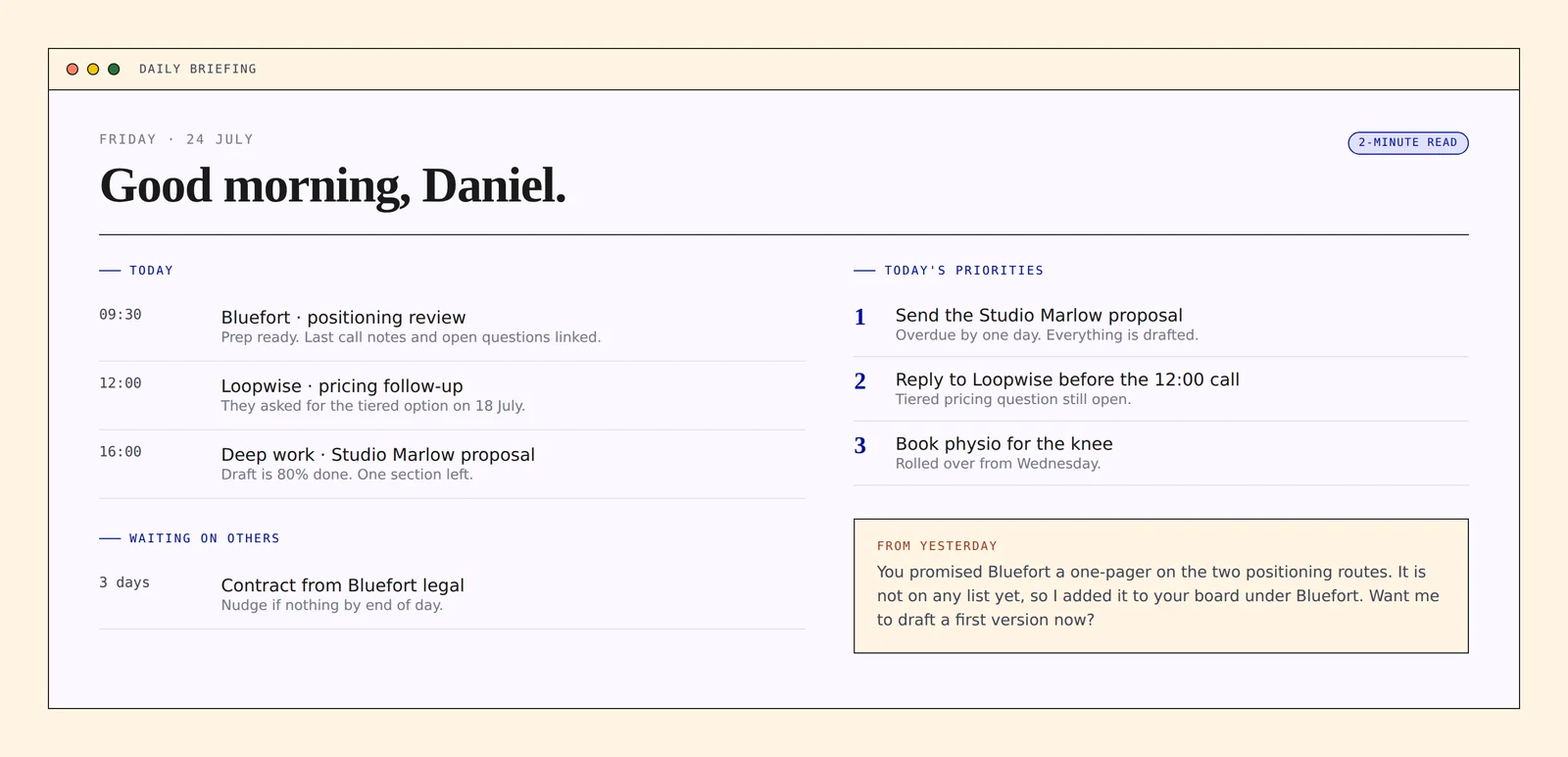
Daily briefing screen: today's calendar, three priorities, what you are waiting on, and a note carried over from yesterday.
The problem

Where does
your knowledge
actually live?

Scattered. Across chats that forget the moment you close them, notes nobody reopens, transcripts nobody reads, files in four different clouds, and the rest in your own head. So every AI conversation starts from zero. You re-explain your context, your projects, and your decisions, over and over, to a tool that resets every time.

Most people are loyal to a chat app and careless with their knowledge. It should be the other way around.

What changed

A second brain was always a good idea. It just cost too much to keep alive.

The concept is old and it is right: one trusted place outside your head for everything you cannot hold in it. Notes, decisions, meetings, ideas, reading. The catch was always the upkeep. Capture, file, tag, link, review. The system only ever worked as hard as you did, and one busy month was enough to let it rot.

Then AI models got good enough to do the librarian's job. That is the real shift. AI did not replace the method. It removed the cost that kept killing it. Take the upkeep away and the compounding starts: every meeting, note, and decision makes the next answer better. Month three beats month one. A chat history never gives you that.

Wiki article written by the AI from six sources, comparing two positioning routes with related notes linked alongside.

Written by the librarian, from six of your own sources. Nobody sat down to write this.

How it works

A library you own.
A librarian you can swap.

Two parts, and one rule that makes the whole thing run itself.

01 / The library

You own it.

Your knowledge lives in a base built around your real work: dedicated folders on your computer, cloud drives, Notion, or a mix. Structured by your projects and areas, not by some template. Portable, exportable, and yours.

02 / The librarian

You can swap it.

An AI reads, organises, links, and maintains the whole thing. Today that librarian is Claude, because right now it is the best at this job. If a better model ships next year, you swap it and keep the library. No migration. No rebuild.

03 / The rule

You never file by hand.

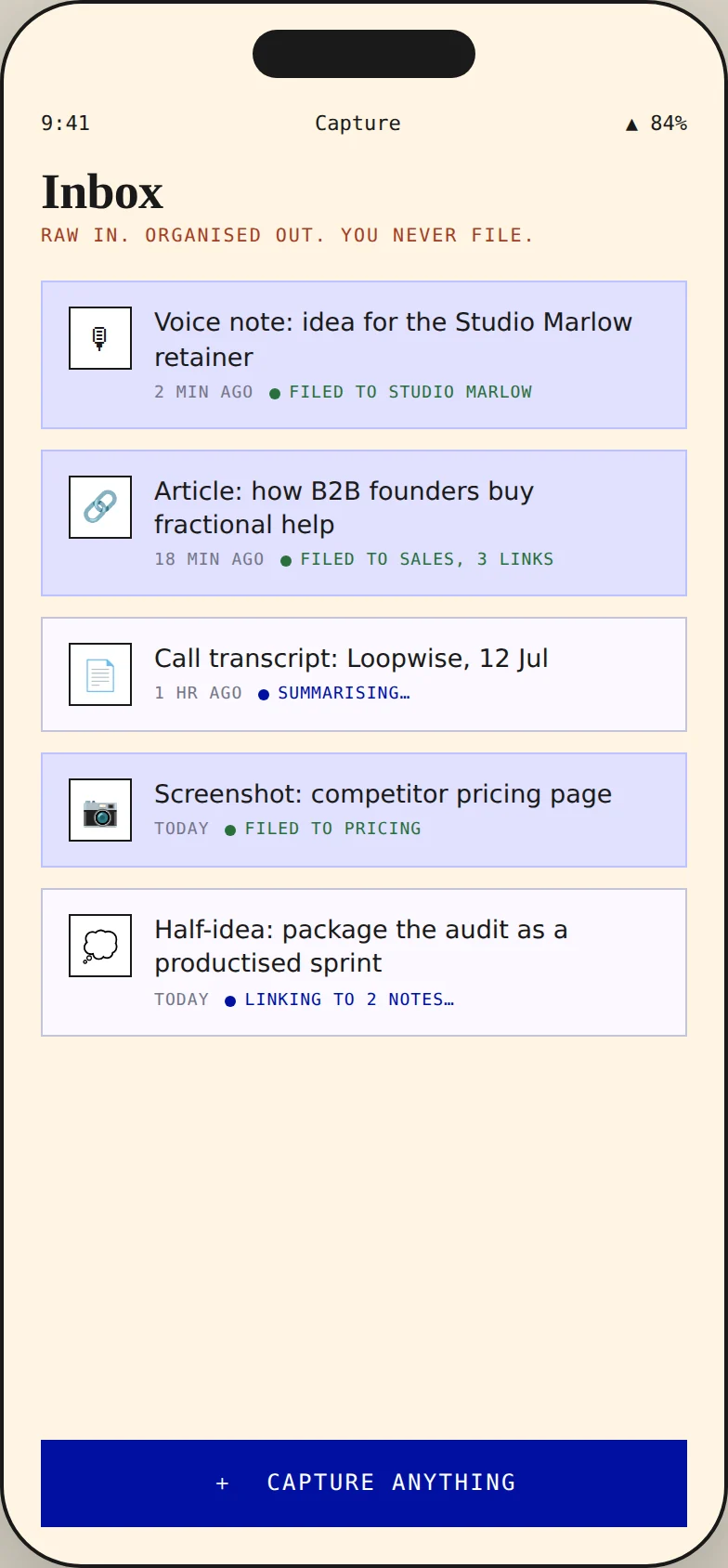
Raw in, organised out. You dump links, voice notes, transcripts, and half-formed ideas from your phone. The librarian files, summarises, and connects everything, and keeps the index current. You never sort a thing.

Knowledge base index: projects and areas in the sidebar, most active documents this week, and a search field.
Capture inbox on a phone: voice notes, links, transcripts and screenshots being filed automatically.

You dump it in raw from your phone. It comes back filed, linked and searchable.

Every day

It works quietly,
before you even ask.

Morning briefing

Your calendar, tasks, and priorities in one summary before your first coffee is done. What used to be 20 minutes of triage is a 2-minute read.

Meeting prep

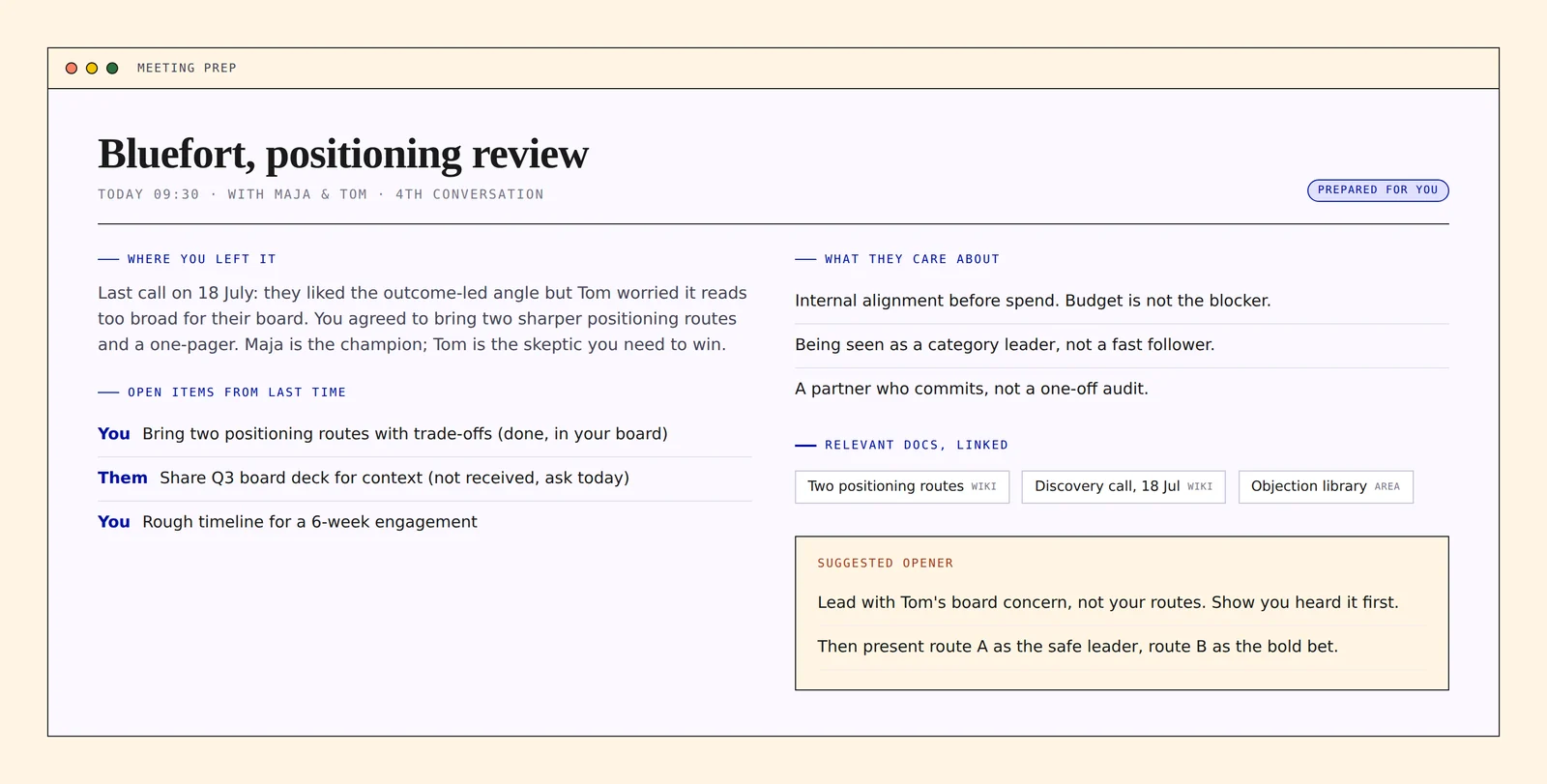
The full history with any client or project, on demand. What used to be half an hour of digging through old notes is one question.

Drafts in your voice

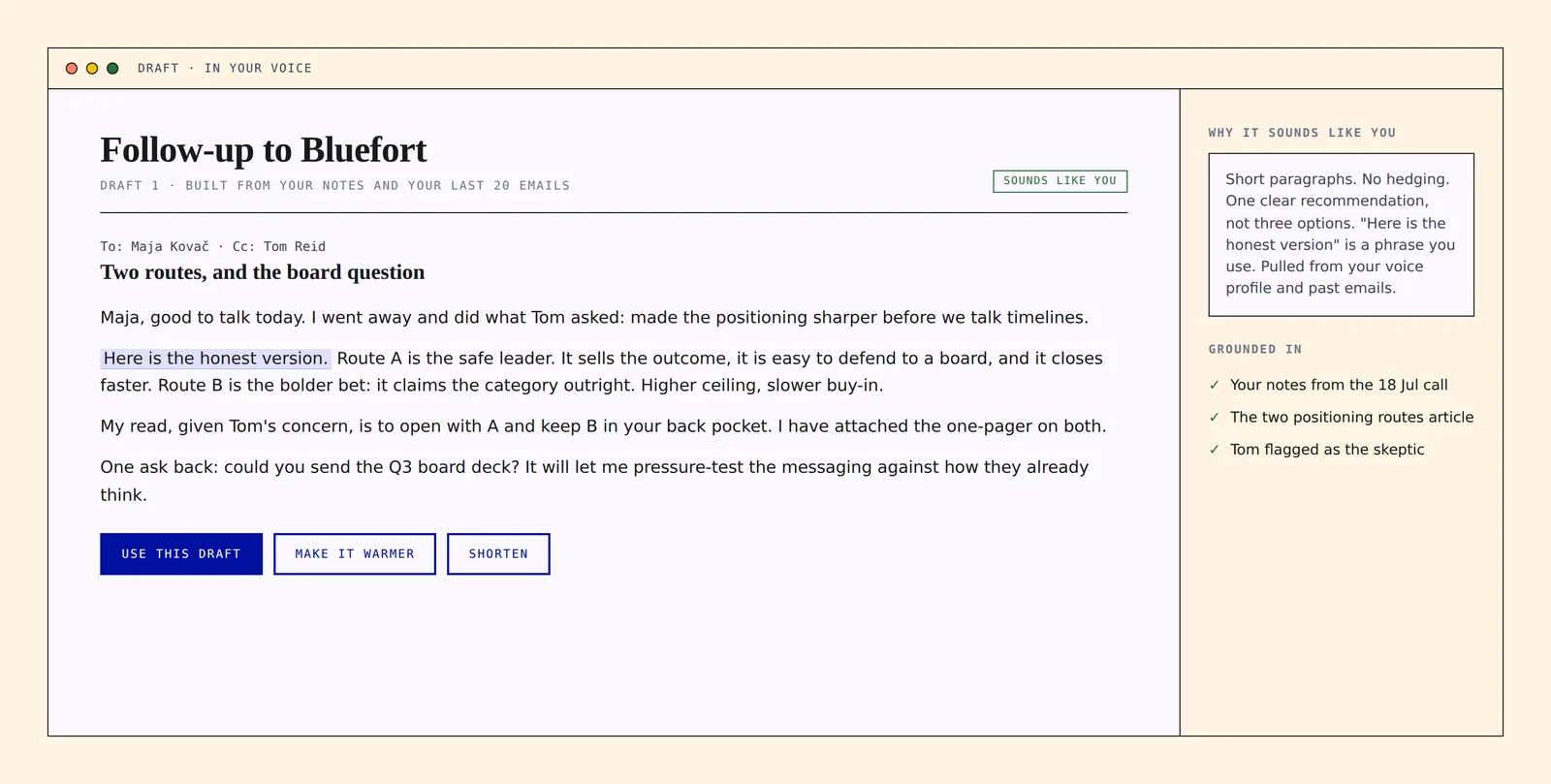
Emails, posts, proposals. First drafts that already sound like you, built on what you actually know. Not the internet's average answer.

Answers from your own knowledge

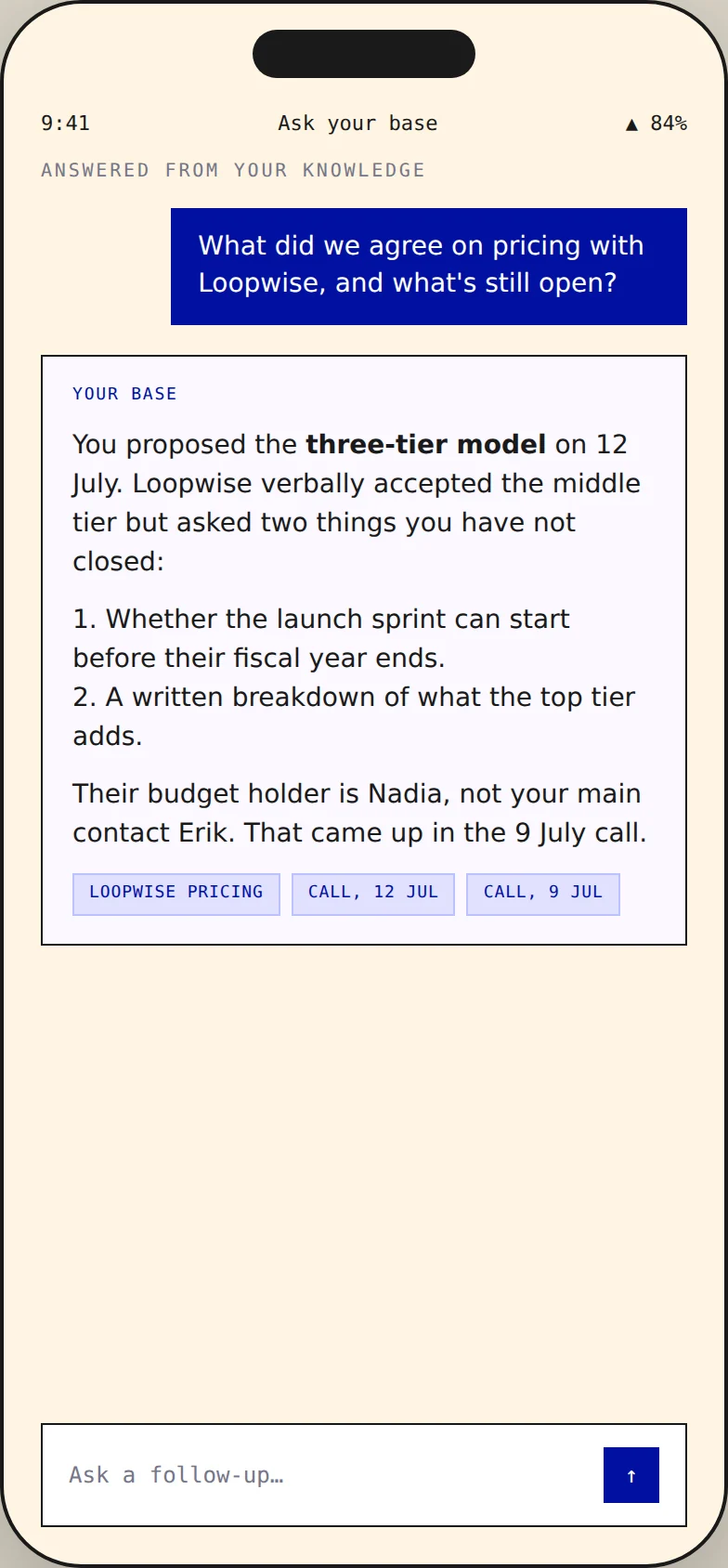
Ask it anything about your work and it answers from your material: your meetings, your decisions, your files. Not a generic reply from the web.

Meeting prep screen: where the last call left off, open items from both sides, what the client cares about, and a suggested opener.
Phone screen answering a question about a client's pricing from the user's own notes, with the source documents cited.

The full history with any client, at your desk or on the way to the meeting

Email draft written in the user's own voice, with a panel explaining which phrasing habits and sources it was built from.

A first draft that already sounds like you, and the reason it does

The result

What four months of
daily use actually
gave back.

These are the numbers from my own system, the one this is built from. Honest caveat up front: it had to be built first. That build is the product.

20+ min to 2 min

Morning triage

Replaced by a briefing I read while the coffee brews.

15-30 min to one question

Meeting prep

The full history with any client, on demand.

400+ documents in one day

One-off ingest

My whole drive distilled into a linked, searchable knowledge base. By hand, that would still be on my someday list.

6 to 10 hours a week

Time back

Conservatively. And I am no longer the single point of failure in my own business.

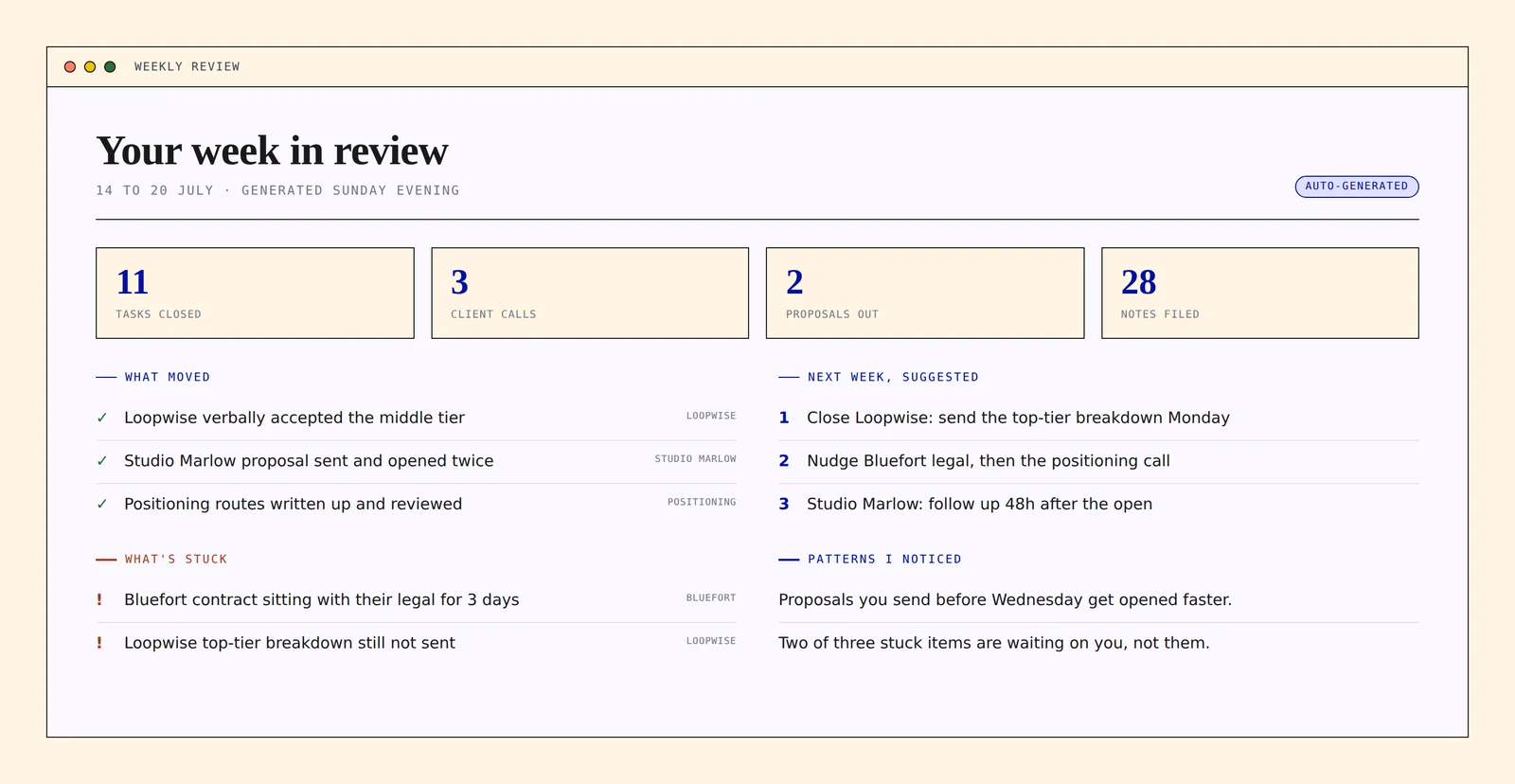
Weekly review generated on Sunday: what moved, what is stuck, next week's suggestions, and patterns noticed across the week.

The Sunday review I owed myself for years and never once wrote

No lock-in

Swap the librarian.
Keep the library.

This is the design decision I do not compromise on. Your knowledge and your history stay yours, in a format that exports cleanly, on tools you control. The AI sitting on top is replaceable by design. Whatever the model market does next quarter, and it will do something, your system survives it. That is your insurance, built in from day one.

Who it is for

The name says founders.
The fit is wider.

FounderOS started with founders, because a founder's knowledge is the business and they feel the loss first. But the shape fits anyone whose work runs on knowledge and decisions.

Founders and CEOs

Your context lives in your head and your inbox. This gets it out, and gives you your mornings back.

Solo experts and fractional leaders

Your knowledge is the product. This makes it searchable, reusable, and impossible to lose.

Teams inside organisations

Shared knowledge that does not walk out the door when someone leaves. Model-agnostic, so it outlasts any one tool decision.

It even coaches my cycling. Reads my ride files, plans my fuelling, tracks my recovery. It runs my Spanish the same way. The point: it shapes to any individual, not just a job title.

Phone screen analysing a gravel ride with distance, power and climbing, plus a fuelling plan for the next long ride. Phone screen with a Spanish practice streak, phrases due for review, and a note explaining it front-loaded travel phrases.
The build

Done for you,
in four weeks.
Then it is yours.

This is not a template you get handed and left to fill in. It is an embedded build, shaped one to one around your real material, so it is useful in week one, not month three.

Week 01 / Kickoff

We map your real projects, areas, and the way you work and write. I learn your context so the system can too.

Week 02 / Build

I set up your base, connect the librarian, and pour in your existing knowledge. Your files, meetings, and decisions, structured and linked.

Week 03 / Shape and test

We run it against your real work and tune it. The proactive layer goes on: briefings, prep, reminders. Support runs through the whole sprint.

Week 04 / Handover

You own everything. The system, the data, the method. It runs without me, and a monthly health check keeps it sharp.

Kickoff conversation where the system maps projects, areas and writing voice, with a checklist filling in as the call goes.

Week one. It learns your world while we talk, so it is useful before the sprint is over.

You own the system and every piece of data in it. Everything exports. You are never locked in, to me or to any tool.

Why now

The sooner you start,
the sooner it compounds.

Every week without a system is another week of knowledge scattering and context lost. The build takes four weeks. The compounding starts the day it goes live and never stops. There is no good reason to let another quarter of your thinking evaporate into chat histories.

See if it fits your work →
Frequently asked

Frequently asked.

If something else is on your mind, put it in the form below. I answer the awkward questions in writing before any call.

Tell me about your work →
Q01 Do I actually own it, or am I renting it from you?

You own it. The system, the structure, and every piece of data. After handover it runs without me. Everything exports to plain files, so you are never trapped.

Q02 What if I want to switch AI models later?

That is the whole design. The AI is the librarian and the librarian is replaceable. Today it is Claude. If something better ships, you swap it and keep your library. No migration, no rebuild.

Q03 Where does my knowledge live? Do I have to use Notion?

Wherever your work already happens. Dedicated folders on your computer, cloud drives, Notion, or a mix. I shape it around your use case, not around one tool.

Q04 Is my data private? What about sensitive material?

You decide what goes in. Processing runs through GDPR-compliant services, and anything you do not want in the cloud can run locally on your machine. The data is yours, start to finish.

Q05 How long does it take, and how involved do I need to be?

Four weeks for the full build. You are involved at kickoff and testing; the heavy lifting is mine. Most of the setup runs in the background while you keep working.

Q06 What does it cost?

It depends on scope, so I price it per build after we talk. It is a done-for-you build, not a subscription to me. You also run a small monthly tooling cost that you own directly, and I am upfront about that on the call.

Q07 What do I have to maintain?

Almost nothing. The librarian keeps itself current, and a monthly health check catches drift. You capture; the system does the filing.

Next step

Want one built
around your work?

Tell me what your work runs on. I will tell you honestly whether this fits, and what a build would look like for you. No sales sequence, no pressure.

Prefer to keep it quick? Send me a DM on LinkedIn instead.

I read every one myself and reply within two working days.